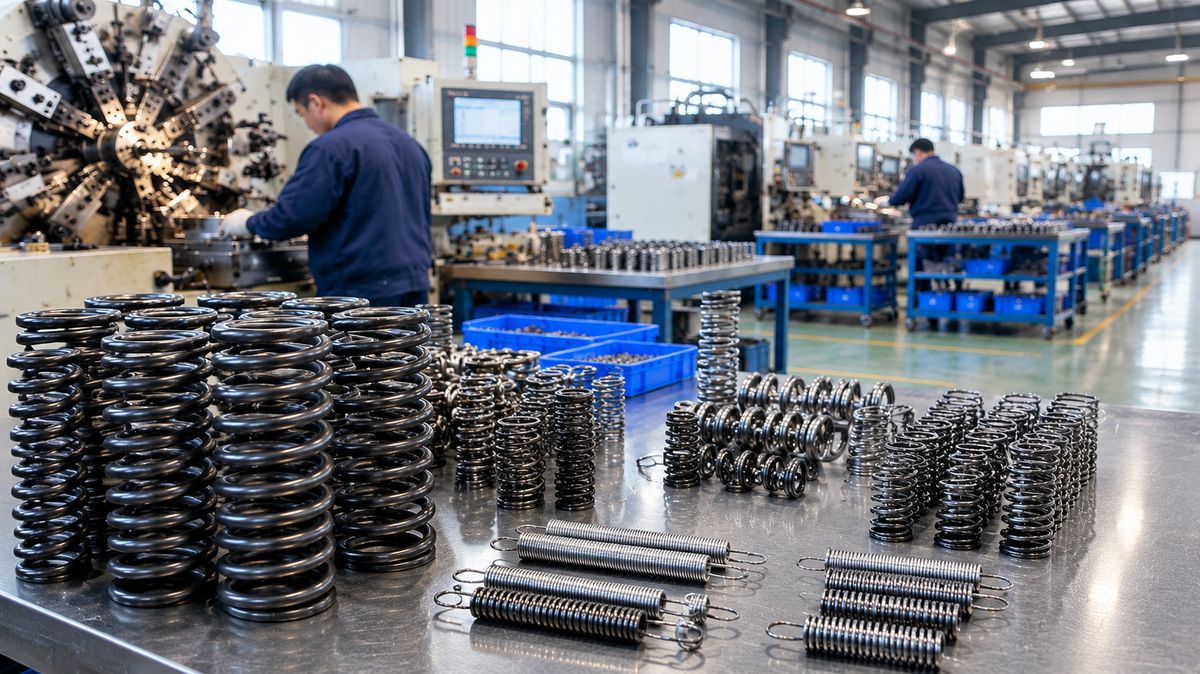
Compression springs
Helical compression springs in cylindrical, conical and barrel profiles. Round wire from 0.2 mm upwards, closed and ground ends where a flat bearing surface is required, preset or set-removed options for accurate free length. Every design is checked at the working point and at solid height, because a spring that is safe under load can still fail when compressed flat.
Typical uses include valves, pumps, fixtures, suspension, actuators, locks and consumer products. Materials: music wire, oil-tempered wire, stainless 304/316, 65Mn, 60Si2Mn and equivalent grades.
Extension springs
Helical extension springs with fixed half-loop or full-loop hooks, flat ends, and movable S-ring or pin-swivel ends. Initial tension is controlled during winding, and the hook is checked separately from the body because the end form is usually the fatigue-critical feature.
Fixed hooks suit light loads and single-plane pull. Movable hooks rotate 360°, remove bending at the end and can be replaced in service — the preferred choice for luggage, exercise equipment, harnesses and serviceable hardware.
Torsion springs
Single and double coil torsion springs with straight or bent arms, defined wind direction and specified leg positions. Torque, angular rate and bending stress are calculated from the free position to the maximum rotation, including the diameter change that occurs while winding.
Die springs and special springs
Rectangular-wire die springs in light, medium, heavy and extra-heavy load classes for press tools and injection moulds. We also produce wave springs, disc springs, spiral power springs, constant-force springs, retaining rings, serpentine springs and stamped spring clips to drawing or sample.
Materials
Material selection drives fatigue life and corrosion resistance more than any other decision. We stock or source music wire, oil-tempered chrome-vanadium wire, stainless 302/304/316, 65Mn, 60Si2Mn, phosphor bronze and beryllium copper. For outdoor or wet service, stainless is normally specified; for high cycle counts at moderate cost, oil-tempered wire is the usual choice.
A predictable process
1. Drawing or sample
Send dimensions, loads, material, surface finish and annual quantity. A photo of an existing part plus its function is usually enough to start.
2. Design and quote
We check stress, geometry, tooling and wire availability, propose corrections where needed, and quote with a tolerance and inspection plan.
3. Sample and volume
A prototype is wound, measured and, where required, fatigue tested. Production then runs against the approved sample and drawing.
Send your spring for a quote
Drawings, samples or a plain description of the mechanism are all welcome. We will reply with a design review and price.